About me
I am working on developing:
- Multifunctional intraORal Assistive technolgy(MORA)
- Bi-directional human-machine interface
- Neuromodulation by close-loop electical stimulaiton
- VR-based system for healthcare applications
- Quantitative and qualitative data analysis
- Uniting virtual and physical world by sensory feedback
- Integrating sensory (e.g., haptic, vibrotactile, electrotactile) feedback for human motor learning and rehabilitation
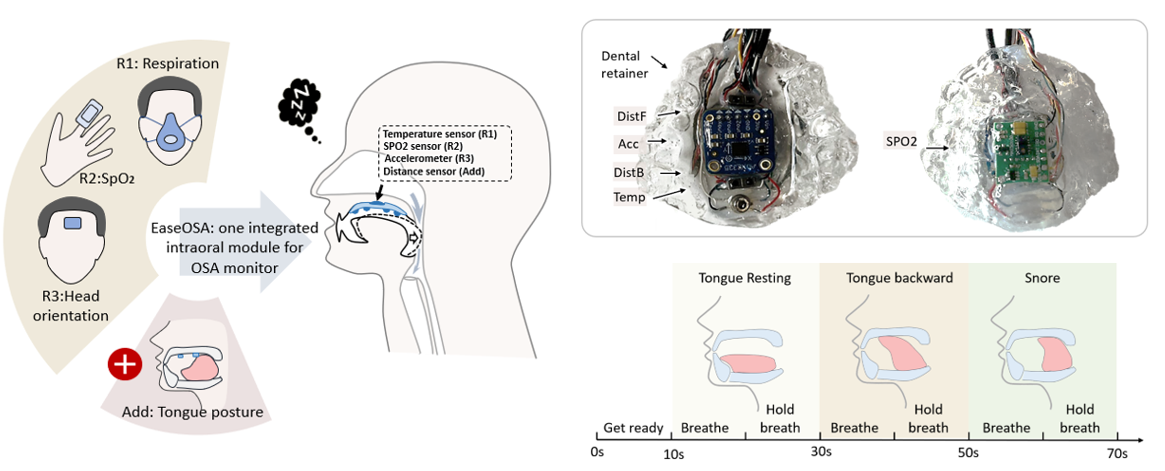
- Healthcare applicaiton for obstructive sleep apnea
Eduaction
- Texas A&M University, College Station Spring 2019 - Summer 2023
- Ph.D. in Electrical Engineering
- Thesis: Multifunctional Intraoral Assistive Technology Driven by Bidirectional Human Machine Interface
- Advisor: Hangue Park (Chair), Joenghee Kim (Co-chair)
- Texas A&M University, College Station Fall 2016 - Fall 2018
- Master of Computer Science
Experience
- Quantitative Neuro Rehabilitation Lab, Texas A&M University Spring 2019 - present
- Graduate Research Assistant
- Integrated Neuro-Prosthesis Lab, Texas A&M University Fall 2018 - Present
- Graduate Research Assistant
- Arbin Instruments, Texas 01/2018 - 04/2018
- Software Engineering Intern
- Center for Bioinformatics and Genomic Systems Engineering, Texas A&M University 07/2017 - 10/2017
- Graduate Student Researcher
Research Projects
I. Multifunctional Intraoral Assistive technology (MORA) with intuitive intraoral commands and sensory feedback
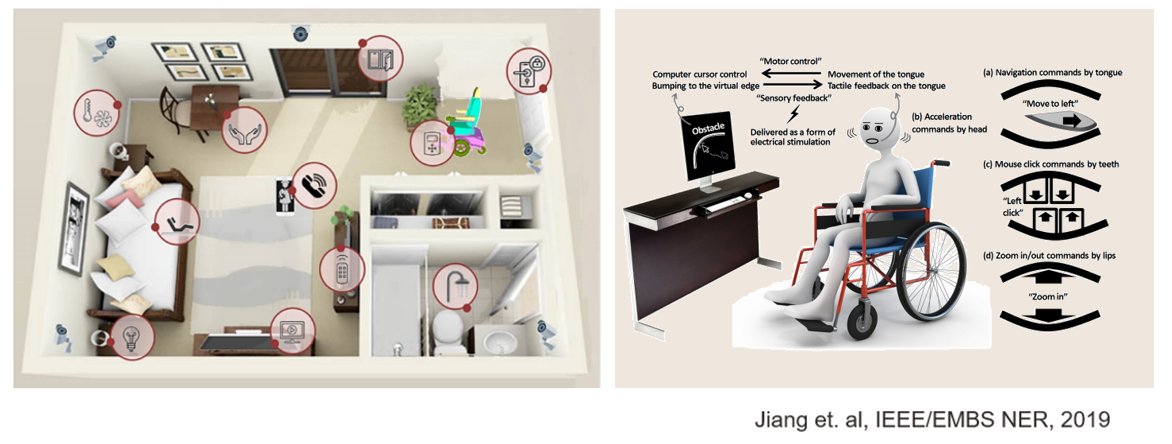
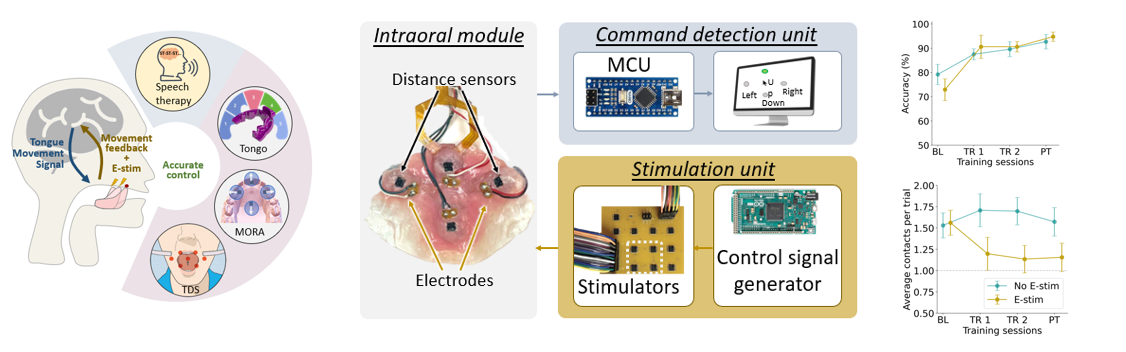
- We proposed a Multifunctional intraORal Assistive technology (MORA) that allows users to control the cursor on the screen by intuitive user-defined tongue commands
without any add-on tracers, and provides sensory feedback to further enhance the intuitiveness of the tongue control. We expect the enhanced intuitiveness of the
proposed AT will increase its acceptability to the people with severe disability.
The advantages of intraoral assistive technology:
- Support Multiple functionality (can be used as a general environment control interface).
- Intraoral interface can be invisible to other people (privacy and dignity).
- Robust, therefore less likely to be effected by the environment.
- Intraoral muscle don’t fatigue as fast as other muscles.
- Intraoral organs are controlled by cranial nerves, which is hardly damaged by SCI.
Multifunctional assistive technology Intuitive command design Biomedical device Hands-free controller Embedded system development Bidrectional Human-computer interface
1. Tongue-controlled hands-free assistive technology (intraoral module for MORA)
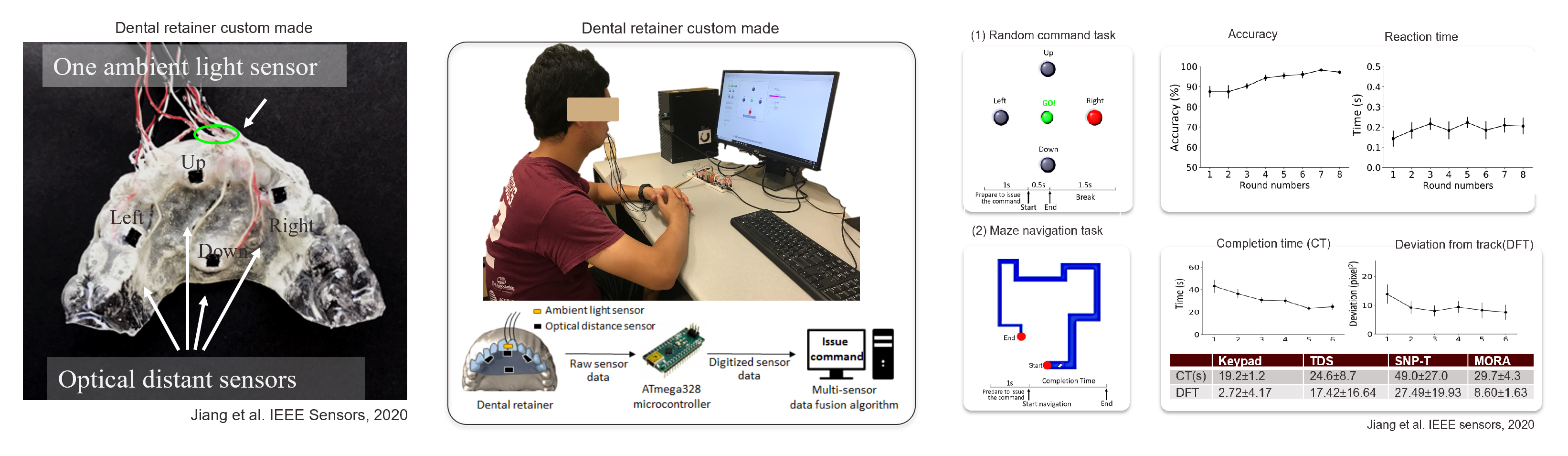
- We have developed an “intraoral module” for tongue-controlled assistive technologies for people withsevere disability to control their environment. And tested it’s basic functionality by doing some some computer access tasks.
- To test the basic functionality of computer access, we tested with 11 subjects for: (1) random command task (target command appeared on the screen in random order, participants need to issue the corresponding command as fast and accurate as possible) and (2) Maze navigation task (guide cursor from start to end as fast and accurate as possible). The result of Maze navigation showed that the average completion time of eleven participants was much faster than SNP, as good as TDS. With this design, the tongue movement inside the mouth can be successfully translated into directional commands for navigation tasks.
- Demo for the Prototype of the intraoral module:https://drive.google.com/file/d/1x3rWHUkTfMlaRTCVqCa1bdhwuiOkryRX/view?usp=sharing
Assistive technology Human-computer interface Biomedical device Embedded system development
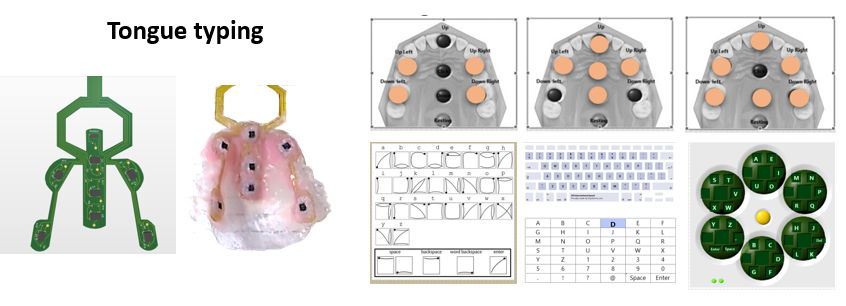
2. Tongue Typing
3. MORA as a Human-Wheelchair Interface(HWI)
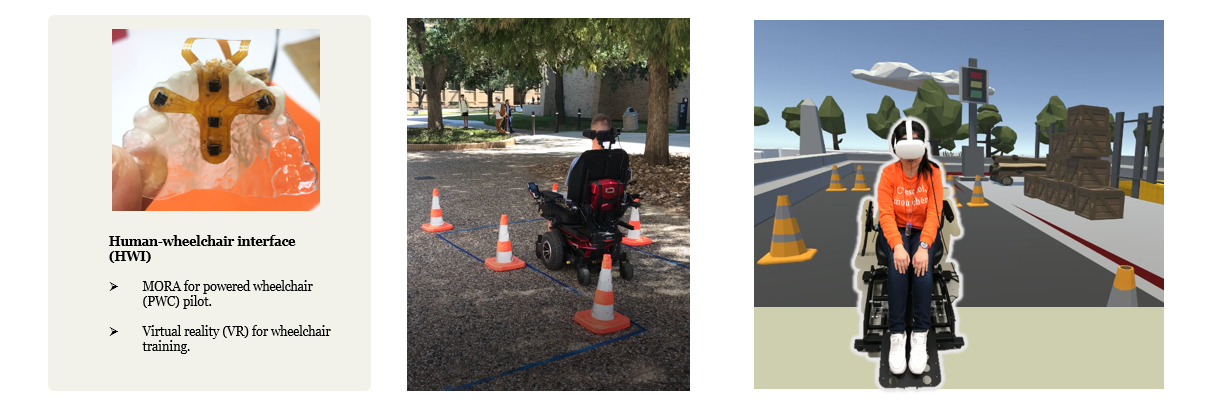
- We are working on developing a MORA-powered wheelchair (PWC) system for hands-free powered wheelchair pilot.
- Piloting the powered wheelchair without training is dangerous task, especially for hands-free controllers. When unintentional commands are given, a novice user may Colliding with Obstacles and get injured. Therefore we developed a VR wheelchair training environment.
Virtual reality Human-computer interface Biomedical device Hands-free controller Embedded system development
4. Improving Tongue Command Accuracy: Unlocking the Power of Electrotactile Feedback Training
II. Speech therapy using real-time closed-loop artificial feedback to the tongue
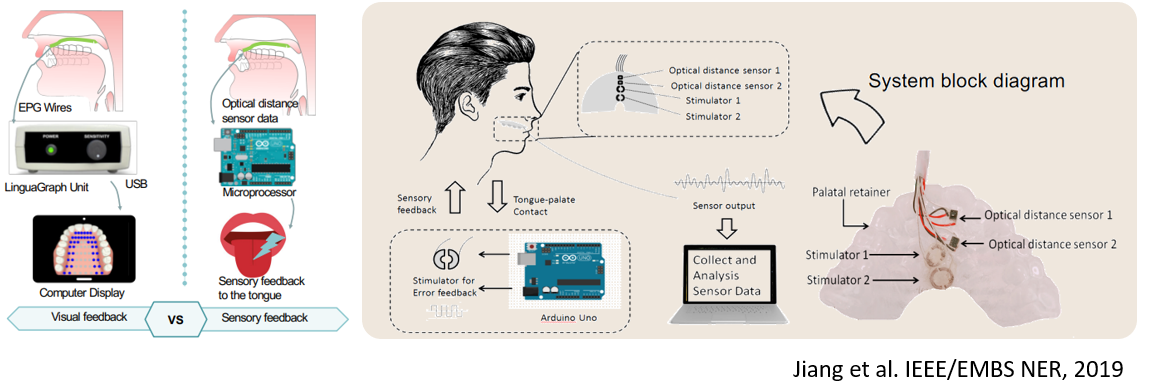
- The purpose of this study was to investigate the importance of providing an error-augmented sensory feedback with proper spatiotemporal resolution for training and enhancing complex tongue motor coordination during speech.
- We present a wearable intraoral system that uses (1) an intraoral palatal retainer to monitor the tongue movement by optical distance sensors and (2) to provide sensory feedback to the tongue by stimulators. If the subject contacts the undesired palatal area during pronunciation, they will get the stimulation as an error feedback on their tongue tip. The result justified our hypothesis that intrinsic sensory feedback can be an effective way for tongue motor learning in speech therapy.
Error-augmented sensory feedbcak Tongue motor control Speech therapy Embedded system development Closed-loop system
III. Tongue motor learning by electrotactile feedback
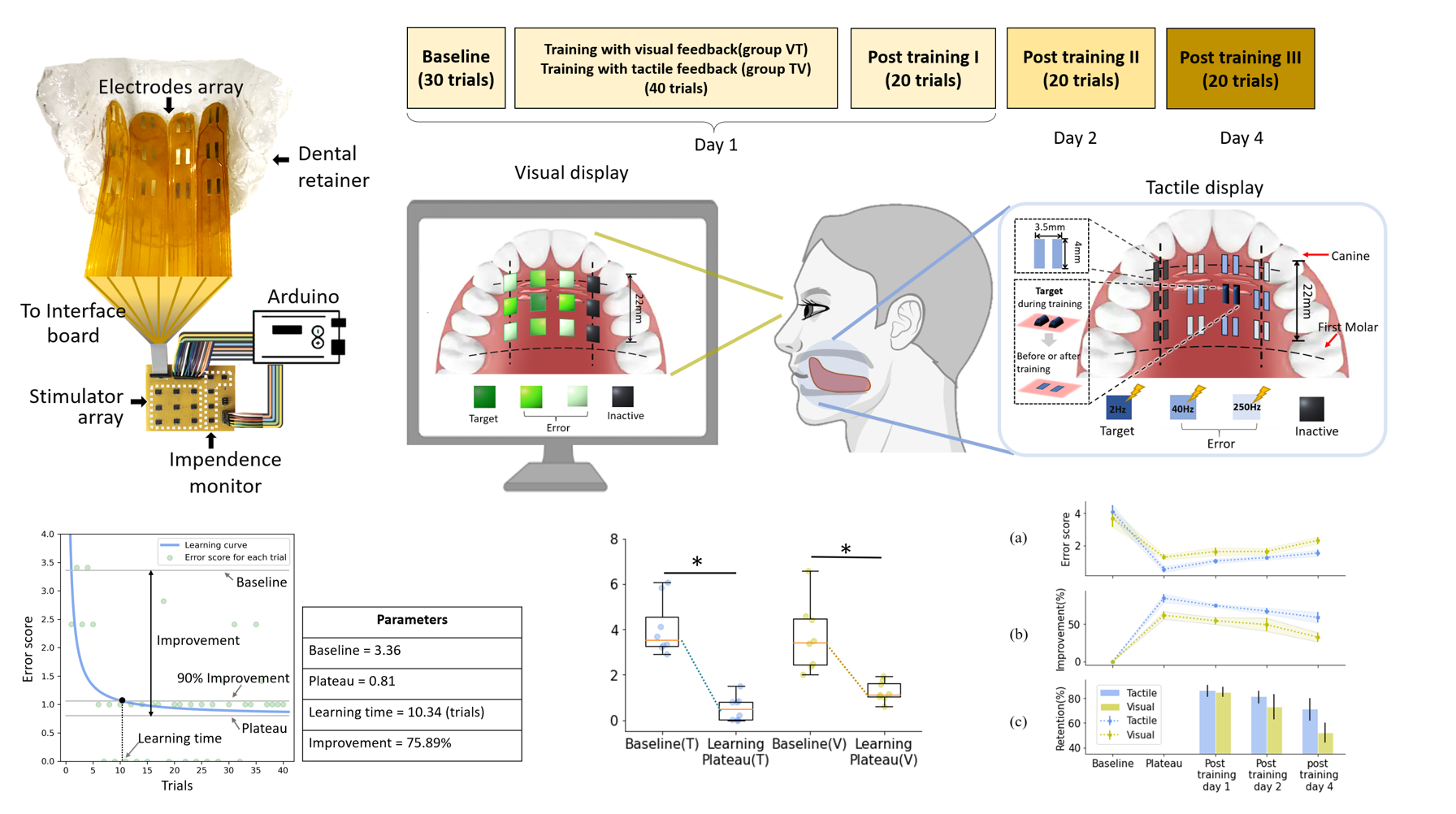
- To avoid the Midas touch effect, tongue commands are usually defined in a complex way to avoid confusion with the daily oral activities, these new tongue movement require a lot of training. To find the more effective way to training the tongue to learn new maneuver, I developed a closed loop wearable intraoral device to improve tongue motor learning efficacy by providing visual or tactile feedback. To test the effectiveness of these methods, I created a custom-made dental retainer with an electrodes array for each subject. For visual training, LED lights on a computer screen were used to provide real-time visual feedback as well as show the target location. For tactile training, different frequency electrical stimulations were used to guide the participant to the target location. The results showed that both methods improved tongue motor control, but tactile training led to stronger retention and faster learning than visual training.
Electrotactile feedback Visual feedback Motor learning tongue Electrical stimulation Intraoral device Augmenting sensory feedbcak
IV. EaseOSA - The Intraoral Monitor for Obstructive Sleep Apnea